
Controlling heat transfer in casting tools is a key quality aspect. It can be improved by selectively applying volumetric aluminium bronze (CuAl9.5Fe1.2) sections in the core of the tools and subsequently depositing these cores with hard-facing H13 tool steel. Directed energy deposition (DED) can be used for both additive manufacturing of aluminium bronze and hard-facing by depositing the filler-material onto a substrate-surface or previously manufactured bodies. A sufficient metallurgical bonding of the deposited filler-material and the underlying layer must be ensured. However, high dilution of the underlying layer and the filler-material negatively affects the desired properties and must be monitored. Optical emission spectroscopy of the DED process-emissions, is investigated by comparing the emission-lines of the individual elements comprising the base and the filler-materials.
Multiple single tracks using aluminium bronze as the filler-material are laser cladded with varying power, onto the two different types of substrates i.e. mild steel (S355) and hot working tool steel (1.2343). Additionally, single tracks of H13 are deposited with varying laser powers onto an additively manufactured core of aluminium bronze. Both resulting in deposition-tracks with varying dilution values. Multiple emission-lines of Cr, Fe, Cu, Al and Mn are detected and measured (line-intensity). Line?intensity?ratios using the element-emission-lines are calculated and correlated with the respective metallographic results of the deposition-tracks (dilution and chemical composition). Deposition-tracks with a higher dilution (CuAl9.5Fe1.2 onto S355/1.2343 as well as H13 onto CuAl9.5Fe1.2) showed an increased line?intensity-ratio of the underlying-material to the filler?material. Moreover, this technology was transferred in a multilayer industrial application.
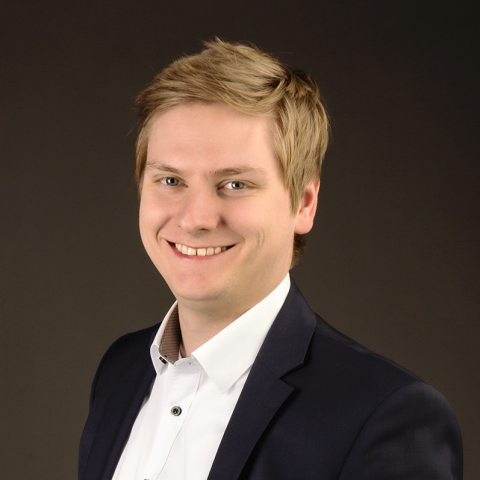
Presenter
Malte Schmidt
Jade University of Applied Sciences

About Malte
Malte Schmidt received B.Eng. and M.Eng. degrees from Jade University of Applied Sciences, Wilhelmshaven, Germany in 2018 and 2020, respectively. In March 2020, he received a Ph.D. scholarship and now works at the laboratory for production, robotics, and welding technology at Jade University in Wilhelmshaven. His main area of work is laser material processing with a focus on directed energy deposition and additive manufacturing. He currently works in the field of optical process monitoring and controlling technologies.
Keywords
- Aluminium Bronze
- Dilution
- Directed Energy Deposition
- Optical Emission Spectroscopy