
Aluminum 6061 is one of the most widely used aluminum alloys across the aerospace, automotive, and general manufacturing industries because of its favorable combination of strength, corrosion resistance, machinability, and commercial availability. Although highly dense aluminum 6061 components can be produced through laser powder bed fusion using conventional Gaussian laser profiles, solidification cracking remains a persistent challenge that has limited the alloy’s broader adoption within the additive manufacturing industry. Consequently, AlSi10Mg is commonly selected as a processable alternative, despite differences in material properties and established industrial use. As advanced beam-shaping technologies become more commercially available, the increased spot size and modified thermal boundary conditions produced by a ring-shaped laser profile may provide a promising pathway for reducing crack formation during processing. This work investigated the influence of ring-beam shaping through multiple statistically structured design-of-experiments studies. The experiments varied ring power, core power, and hatch spacing, while also evaluating the influence of enabling or disabling skywriting during fabrication. The central focus of this work was a first-of-its-kind optical system for additive manufacturing that integrated a 4 kW Coherent ARM fiber laser with an approximately 460 µm spot size into an Open Additive PANDA laser powder bed fusion machine. Across seven experimental builds, 10 mm square specimens were produced under systematically varied processing conditions. The samples were sectioned along the x–z plane, mounted, polished, and evaluated using optical microscopy to characterize the presence and distribution of cracks.
Presenter
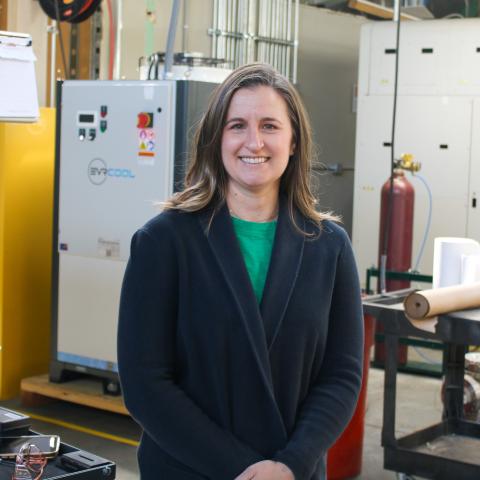
Christine Rice
THE Ohio State University
About Christine
Christine is an undergraduate researcher at Ohio State University's Center for Design and Manufacturing Excellence (CDME), where she works in additive manufacturing and advanced materials, including Ni-Ti. She is pursuing a degree in Industrial and Systems Engineering with a minor in Industrial Design. Before returning to school, Christine spent over a decade in the culinary world as a chef, food stylist, and photographer, working alongside Michelin-starred chefs and running her own restaurant. She brings a creative, design-driven perspective to her engineering and research work.
Keywords
- Aluminum 6061
- Laser Powder Bed Fusion
- Ring Laser
- Ring-Beam Shaping