
Structured metal surfaces are increasingly used as functional interfaces in metal-polymer hybrid components because they enable mechanical interlocking without additional joining elements or adhesives. In a two-step process, a continuous-wave (cw) fiber laser first generates cavities in the metal surface, which are subsequently filled by the polymer during joining. This study focuses on the laser structuring step and investigates the mechanisms governing cavity formation and melt redistribution in aluminum EN AW-5754 and stainless steel 1.4301. Vaporization, melt ejection and internal roughness are analyzed as complementary indicators of the underlying process dynamics. Laser scanning microscopy, metallographic sections, high-speed imaging, SEM analysis of ejected particles and wavelength-selective process-emission measurements are combined to relate the final cavity morphology to transient melt-flow behavior. Cavity formation is primarily melt-dominated: recoil pressure and Marangoni convection displace molten material, while viscosity, thermal conductivity, repeated remelting and rapid resolidification determine the final recast morphology. Aluminum exhibits stronger melt mobility, coarser droplet ejection and higher internal roughness than stainless steel, whereas stainless steel forms smoother and more stable cavities although stronger optical emissions are detected. The findings provide a mechanistic basis for selecting material-specific process windows for future metal-polymer joining studies, but mechanical validation of bond strength is beyond the scope of this work.
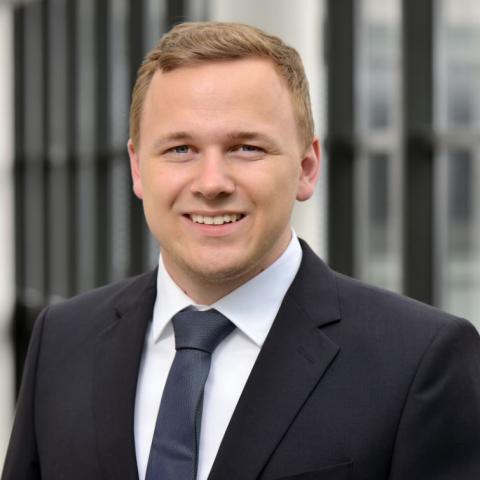
Presenter
Christoph Wortmann
Fraunhofer Institute for Laser Technology

About Christoph
Christoph Wortmann was born in Germany and studied mechanical engineering at the RWTH Aachen. During his studies, he worked as a research assistant at the Fraunhofer Institute for Laser Technology in Aachen in the field of micro- and nanostructuring of glasses. After completing his master's degree, he joined the Fraunhofer Institute for Laser Technology as a research associate in the field of joining plastics and transparent materials. The focus of his work is on laser-based joining of metals and polymers.
Keywords
- Continuous-Wave Laser Structuring
- Interaction Of Laser And Metal
- Laser Cavity Formation
- Laser-Based Hybrid Joining Of Metal-Polymer
- Laser-Based Structuring