
This abstract and keynote speech addresses the challenges in the development of additive manufacturing (AM) using selective laser melting (SLM) technology. With this technique, AM can produce superior and sustainable parts by the application of bionic design. In the last two decades L-PBF increased it’s productivity by a factor of 200, however it still misses commercial competitiveness. One of the main current bottlenecks lies in the high production costs of more than €1000 per kilogram of manufactured
material. These have their cause mainly in inefficient build up rates and expensive powder costs. Another constraint is the need for ensuring consistent and high-quality parts, requiring a certified quality assurance process.
To address these challenges, we developed a project idea whose goal it is to develop an optimized AM product by integrating a ring-mode laser as well as a manufacturing monitoring system for quality assurance and faster build rates. The ultimate goal is to achieve a certified and profitable product with target costs of less than €100 per kilogram of certified material to be competitive in the market.
The proposed solution aims to improve the efficiency of the SLM process, resulting in lower production costs and faster production rates, while maintaining consistent high-quality parts. The ring-mode laser provides more uniform energy distribution and reduces thermal gradients, improving the material properties and reducing distortion int the manufactured part. This will move the threshold for the maximum robust melting productivity by a factor of ten due to higher laser scanning speeds and an improved layer thickness.
The planned manufacturing monitoring system which is combined with quick destructive dynamic specimen testing ensures consistent quality while detecting and correcting any defects during production. This allows the approval of static and fatigue material properties with the certified absence of pores with a diameter bigger than 0.1 mm.
The optimized SLM process which will be developed in this project idea could enable a more cost-effective production of metal parts and reduce the entry barriers for small and medium-sized corporations. Overall, the proposed solution could enhance the metal additive manufacturing industry, enabling competitive and sustainable production of high-quality metal parts for all kinds of applications.
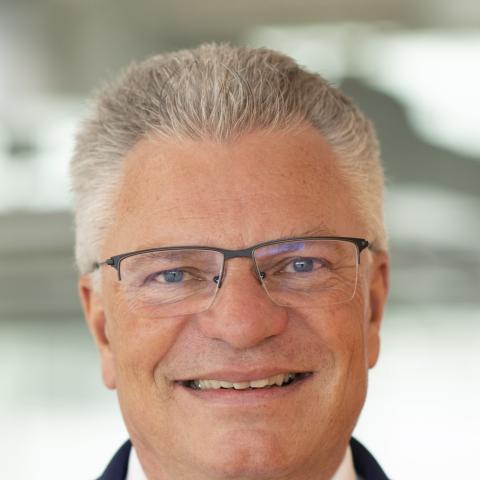
Presenter
Claus Emmelmann
Hamburg University of Technology (TUHH), Institute of Laser and System Technologies (iLAS)

About Claus
Prof. Dr.-Ing. Claus Emmelmann is heading the Institute of Laser and System Technologies at Hamburg University of Technology since the year 2001. In addition, in 2009 he initiated with the Free und Hanse-City Hamburg the foundation of the LZN Laser Zentrum Nord GmbH, with which he successfully transferred laser-based production research to the scientific and industrial communities worldwide with more than 100 employees and a revenue of more than 8 Mio. Euro in 2017 as its CEO.
In 2018 the LZN was incorporated into the Fraunhofer-Gesellschaft as the Fraunhofer Research Institution for Additive Production Technologies (IAPT), which Claus Emmelmann headed as its CEO until mid of 2020. With his team of researchers, he is performing education, research and development in the field of laser additive manufacturing, ablation, cutting and welding as well as design for superior bionic functional products and analysis of laser components and systems for automotive, shipyard, aircraft, tooling, polymer and medical industry. As an author of more than 600 publications, he already accompanied more than 30 PhD-candidates for reaching their scientific degree “Dr.-Ing.” and supported the foundation of 7 start-up companies. After receiving his Dipl.-Ing. (MSc) degree of mechanical engineering sciences at the University of
Hannover in 1986 Claus Emmelmann established the Department of Production Technology of the Laser Zentrum Hannover directed by Professor Dr.-Ing. H.K. Tönshoff. 1991 he received his Dr.-Ing. (PhD) degree with a thesis about Laser Beam Cutting of Ceramics. Within his following 10 years industrial career he successfully expanded the business unit of solid state lasers at the worldwide leading laser manufacturer Rofin Sinar GmbH in Hamburg until 2001 from 0,1 to 20 Mio. Euro revenue
with more than 100 employees. Awards for his special success have been so far: "Innovation Award of the German Economy" in 2014, Circle of the Best 3 for the nomination of the "future price" of the German President in 2015 and "Hamburg Citizen of the Year" 2016 in the category "economy”.
Keywords
- 3D Printing